




It Might Be Coming From C1.
You know the spot.
Top of the shoulder.
Right along the upper trap.
Sometimes into the base of the skull.
You stretch it.
You roll it.
You strengthen around it.
It improves… then comes back.
If that sounds familiar, the issue may not actually be your shoulder.

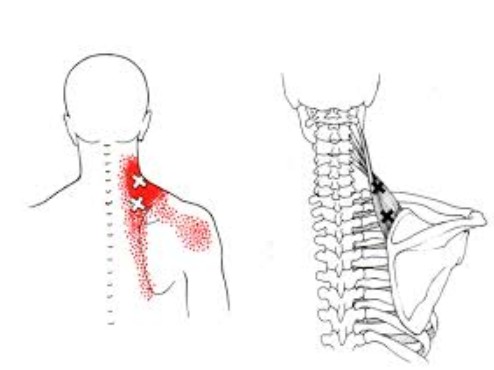
The Muscle Involved: Levator Scapulae
The pain pattern most people describe here is typically the levator scapulae.
It attaches:
- From C1–C4 (the top four cervical vertebrae)
- To the upper inner border of the shoulder blade
Its roles:
- Elevating the scapula
- Assisting neck rotation and side-bending
- Stabilising the shoulder during load
Here’s the important part:
It begins at C1 — the atlas.
Why C1 Changes Everything
C1 sits directly under the skull and surrounds the brainstem.
It plays a major role in:
- Regulating muscle tone
- Postural reflexes
- Head and neck positioning
- Nervous system balance
If C1 is not moving appropriately from:
- Old sporting injuries
- Falls
- Whiplash
- Birth stress
- Repetitive loading over time
The body compensates.
And the levator scapulae is often one of the first muscles to step in.
What That Compensation Looks Like
When C1 isn’t moving well, the nervous system may increase resting tone in the muscles that attach there to create stability.
Over time, the levator scapulae becomes:
- Chronically overactive
- Guarded
- Tender to touch
- Prone to trigger points
- Tight but not truly “short”
This leads to:
- One-sided upper trap tension
- Reduced neck rotation
- Recurring headaches
- Shoulder discomfort that doesn’t resolve long-term
The muscle isn’t weak.
It’s protecting.
Why Treatment to the Trap Only Helps Temporarily
Massage, stretching, dry needling and mobility work improve:
- Local circulation
- Tissue extensibility
- Short-term muscle tone
But if the neurological input from C1 hasn’t changed, the brain still senses instability at the top of the neck.
So the muscle tightens again.
The body will always prioritise stability over comfort.
The Nervous System Layer
C1 sits next to the brainstem — the control centre for:
- Baseline muscle tone
- Stress response
- Hormonal regulation
- Recovery capacity
If there’s altered input at this level, the system can remain subtly on guard.
For active women balancing:
- Training load
- Life stress
- Hormonal fluctuations
That added nervous system load makes compensatory patterns stick even harder.
Where Blair Upper Cervical Care Fits
Blair Upper Cervical care focuses specifically on the joint function and biomechanics of C1 in relation to the skull.
It is:
- Precise
- Imaging-based
- Gentle
- No twisting or aggressive manipulation
The goal isn’t to treat the trap directly.
It’s to restore proper mechanics and neurological communication at the top of the spine.
When C1 moves well and input normalises, the body can:
- Reduce unnecessary muscle guarding
- Decrease levator scapulae overactivity
- Improve neck mobility
- Break the recurring tension cycle
Often, the shoulder pain resolves because the underlying stabilisation pattern is no longer needed.